The footwear resale market is a real industry now. What used to be the domain of eBay hustle and StockX speculation has expanded into legitimate retail — authorised dealers, multi-brand running specialists, athletic wear distributors, and brick-and-mortar stores that have built Shopify stores to reach customers beyond their postcode.
If you're in that category — carrying Nike, Adidas, New Balance, Brooks, ASICS, Hoka, or any combination of major athletic footwear brands — you have a specific product photography problem that a photographer can't efficiently solve.
The shoe photo problem is worse than most categories
Consider what "one SKU" means for footwear. A single shoe model typically comes in:
- 6–12 sizes
- Multiple widths (standard, wide, narrow)
- 4–8 colorways
In Shopify's data model, a shoe that comes in 10 sizes and 6 colors is 60 variants — but you still want at least one hero image per colorway, which means 6 photos minimum for that one shoe. A store carrying 50 active models needs at minimum 300 hero images. A store carrying 200 models — not unusual for a running specialty retailer — needs well over 1,000.
That's before you account for seasonal updates, limited edition colorways, and the fact that Nike and Adidas both release hundreds of new models per year.
Why Nike and Adidas already have what you need
Here's the thing about selling major athletic brands: their marketing spend dwarfs anything you could independently produce. Nike's annual marketing budget is measured in billions. The photography they've commissioned for every colorway of every shoe they've ever released is extraordinary in both volume and quality.
Those photos are out there. Product databases, press sites, the brands' own media portals, and simply Google's index all contain high-quality, white-background packshots for the vast majority of Nike, Adidas, New Balance, and other major brand footwear that's been released in the past decade.
The problem isn't that the photos don't exist. It's the workflow of finding, retrieving, and uploading them for 2,000 products without it taking 200 hours of someone's time.
Renegade, a running equipment and footwear retailer with 4,000+ SKUs, captured this exactly: finding photos for each product one at a time was simply taking too long. A tool that automated the search brought their entire catalogue up to date in a day.
Specific approaches for shoe resellers
Nike and Jordan Brand
Nike maintains a partner portal for authorised retailers. If you're an official Nike account, you have access to official product imagery. The challenge is that it requires maintaining the relationship and knowing where to look — the portal is not the most intuitive thing to navigate if you're not using it regularly.
For the web-indexed route: Nike publishes extremely clean product photography on their own website and via media partners. Every major model from the past several years has findable white-background imagery.
Adidas and Reebok
Similar story — official partner assets are available via Adidas' B2B portal for accounts that qualify. Outside that, Adidas product imagery is among the most widely indexed in the athletic footwear category.
New Balance
New Balance has invested significantly in their web presence over the past few years. Product photography for current and recent models is generally findable. For older models or colourways, availability drops off.
Specialty running brands (Brooks, ASICS, Hoka, Saucony)
Running specialty brands maintain solid media presences because they rely heavily on specialist retailers for distribution. ASICS in particular is known for well-maintained press assets. Brooks and Hoka have improved their digital asset availability significantly as those brands have grown.
What to watch out for with shoe imagery
A few things that are specific to footwear when sourcing product photos:
- Colorway accuracy matters a lot. "Grey/White/Black" and "Black/White/Grey" are different shoes to a customer. Make sure the image you're uploading actually matches the colorway you're selling, not just the model.
- Size matters for the listing, not the photo. You don't need separate photos per size — one hero image per colorway is the standard. Don't get caught in the trap of trying to photograph every variant.
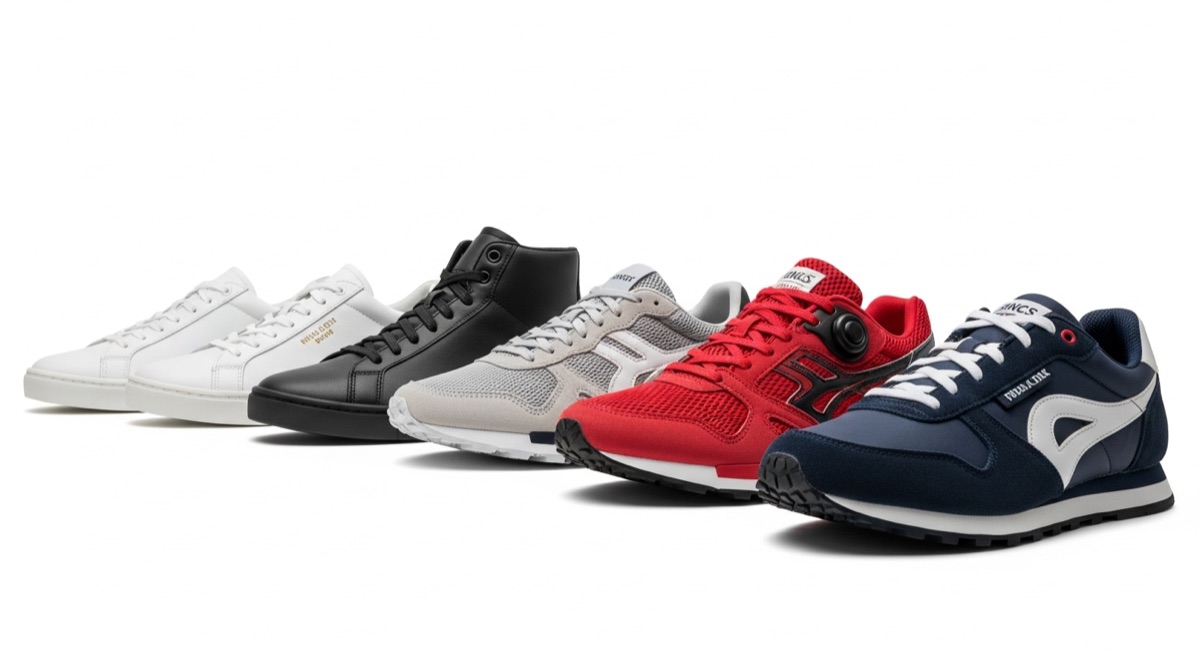
- Pair shots vs. single shoe. Most modern ecommerce shoe listings show a pair shot (both shoes) rather than a single shoe. When reviewing images for your listings, prefer pair shots for the hero image.
- Watch for old colorways. Sometimes a search returns a photo of a model in a colorway that's been discontinued. It's worth a quick sanity check that the image matches the actual product you're selling.
Building a scalable photo workflow for a shoe store
For a footwear reseller with a large catalogue, here's what a sensible workflow looks like:
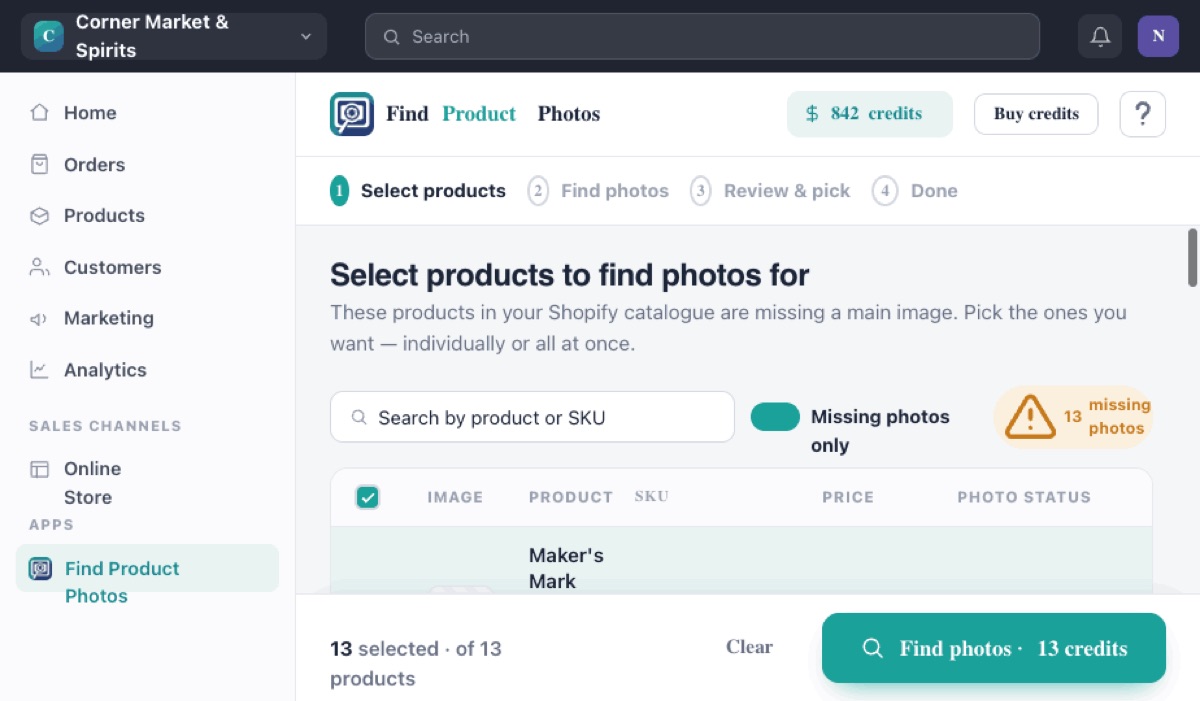
- Bulk-source for existing catalogue. Use Find Professional Product Photos to run your current Shopify catalogue through automated search. For a typical 2,000-SKU shoe store, this surfaces images for the vast majority of products within a few hours.
- Manual review and approval. Spend an afternoon reviewing the results. For colorway-critical products, double-check that the image matches your actual inventory.
- Fill gaps with brand portals. For the products where automated search came up short — newer models, unusual colorways — check your brand rep or partner portal.
- New product intake process. When you add new products to your Shopify store, run them through the same tool before publishing. New products should launch with images, not show as "no image available."
The recurring cost is low. Once your existing catalogue is covered, keeping up with new additions is a matter of minutes per batch, not days per product.
Get your shoe catalogue fully photographed
Find professional brand photos for your Nike, Adidas, and running brand SKUs. Start with 10 free credits.
Try it on Shopify →The SEO angle: why this matters beyond just looking good
There's a direct connection between product images and organic traffic for shoe stores. Google Images and Google Shopping both index product photos from your Shopify store. A product without a photo is invisible in both.
For branded footwear searches — and there are a lot of them, "Nike Air Max 90 white" gets tens of thousands of searches a month — having the correct product image attached to your listing is part of how Google determines relevance. An accurate, high-quality product photo isn't just good for conversion rates. It's part of the signal that tells Google your listing is legitimate and relevant.
Shoe resellers who've gone from no images to full catalogue coverage report meaningful increases in organic traffic within weeks of the change — not because they did anything sophisticated, but because Google could finally see what they were selling.